Men and women inherit Fabry disease differently
Each of us has information, called DNA, coded in our cells. We inherit this DNA from our parents. Males inherit one X and one Y chromosome, while females inherit two X chromosomes. Because the GLA variant is found on the X chromosome, Fabry disease can be passed down by either parent.
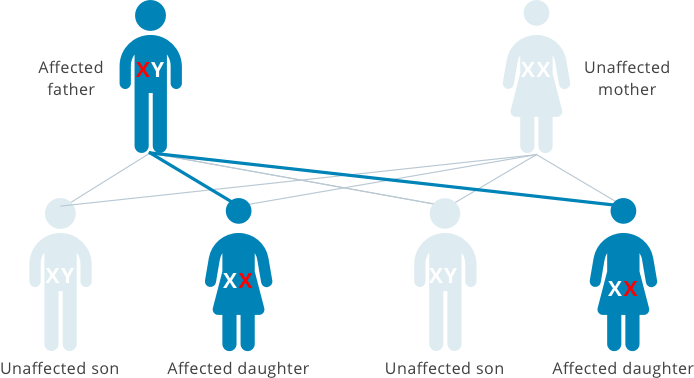
A father with Fabry disease passes along his variant to all of his daughters. This is because daughters get their father’s only X chromosome with the mutated GLA variant. A father with Fabry disease never passes the GLA variant to his sons, because sons get a Y chromosome from their fathers.
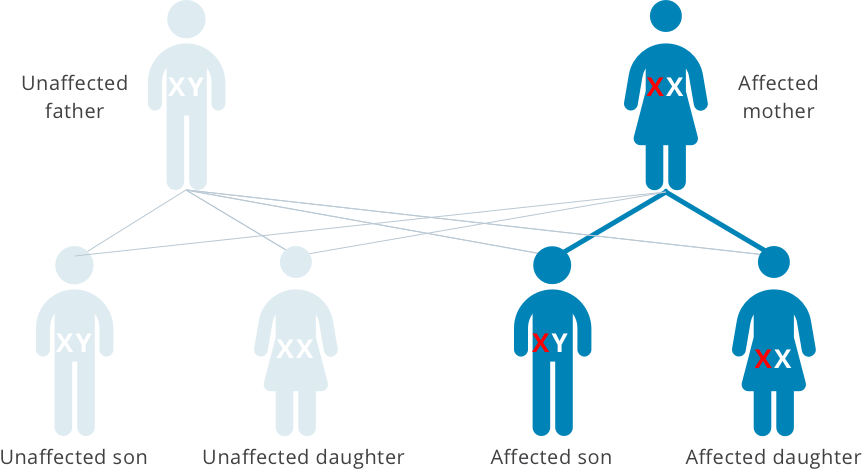
A mother who has the GLA variant on one of her two X chromosomes has a 50% chance of passing down Fabry disease to each of her children (male or female). Because males only have one X chromosome, if they inherit the variant, they will all develop Fabry disease. In affected females, the GLA gene may work normally in some parts of the body but not others. This is believed to be one reason why females have more variable symptoms than males.
In rare cases, Fabry disease may not be inherited. Mutations may spontaneously occur and be unique to the individual. These are known as de novo mutations. However, these individuals may still be able to pass the disease on to their children.
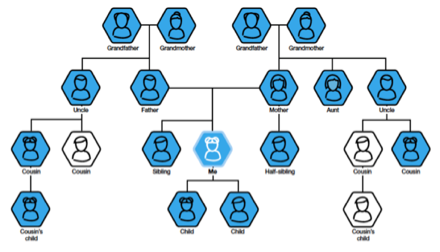
Determine who in your family may be at risk for Fabry disease.
“In the early stages of being diagnosed with the disease, doctors acted like I didn’t have any symptoms because I was a woman. Talk about frustrating! Contrary to popular belief, women and girls can have severe Fabry symptoms. I am one of them.” – Rebecca, a woman with Fabry disease, on her life experiences.
Watch her full story >


Debunk past myths with current facts.